Beyond Tabs: How AI Browsers Are Rewriting the Web Entry Point
Published On
October 23, 2025
Author
Kunal Bhardwaj
Services
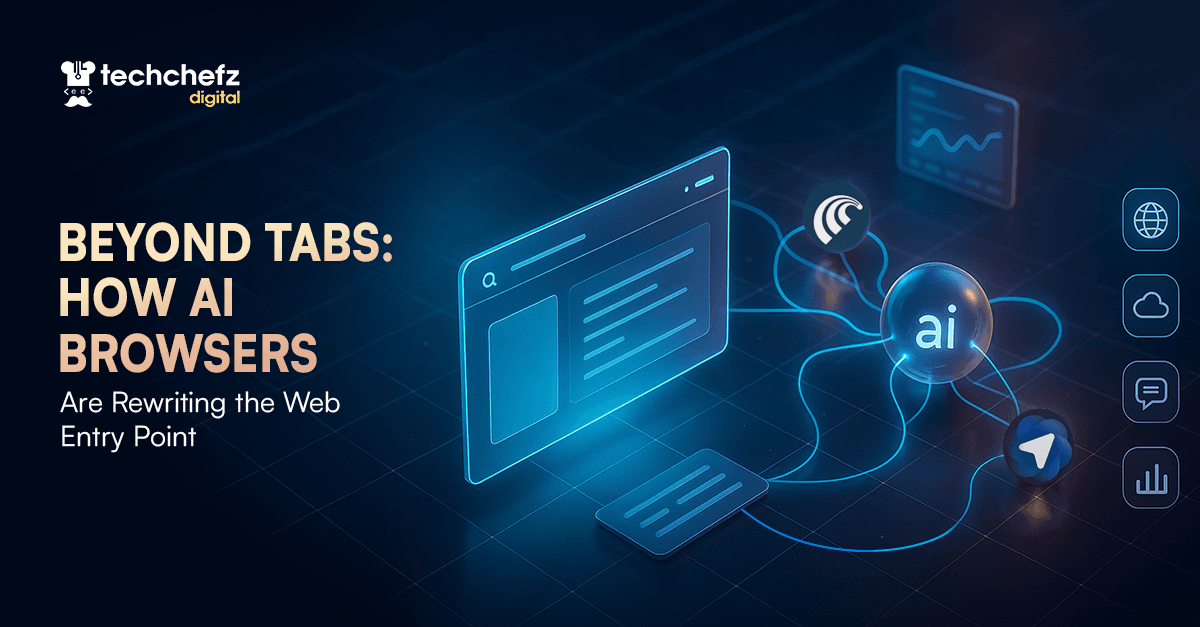
The Browser Is No Longer Just a Window to the Web
For over two decades, browsers like Chrome, Safari, and Edge defined how we explored the internet, one tab, one search, one click at a time. But in 2025, that rhythm broke.
Enter the AI Browser revolution — led by ChatGPT Atlas and Perplexity Comet — reshaping how we discover, summarize, and act online. These aren’t upgrades to your old browser. They’re intelligent copilots, designed to understand your goals and execute tasks instead of just displaying pages.
No more jumping between 10 tabs to compare flights, prices, or product reviews. AI browsers do it for you, instantly summarizing, analyzing, and even taking action.
“The browser is no longer where your search begins — it’s where your work finishes.”
From intent-based search to autonomous browsing, 2026 marks the beginning of what many are calling the Agentic Web Era.
AI browsers are evolving from passive gateways into proactive digital partners, built to bridge the gap between user intent and real-world outcomes.
ChatGPT Atlas – The AI Browser That Plans, Reads, and Acts
When OpenAI announced ChatGPT Atlas, it positioned the browser as an agent rather than an interface.
Atlas combines ChatGPT’s conversational intelligence with task automation, allowing users to:
- Read and summarize entire pages in one click.
- Compare multiple tabs and generate contextual reports.
- Use Agent Mode to complete multi-step tasks — like planning travel, drafting emails, or curating research notes.
Atlas’s context memory retains what you’ve been reading, letting it continue conversations across sessions, without ever leaving the page. Its key strengths:
- Intent Recognition – Understands “Book me a flight under ₹25 k to Bangalore.”
- On-Page Action – Fills forms, sends mails, and saves results automatically.
- Contextual Summaries – Explains what’s new, what changed, and what matters.
- Privacy by Design – Users can disable data retention or limit model memory.
Perplexity Comet – From “Search to Do” in a Single Click
Perplexity AI’s Comet takes the same goal—speed, clarity, and action—and makes it public. Built on Chromium, Comet merges Perplexity’s Answer Engine with a task-execution sidebar that can shop, book, compare, or email—all without multiple tabs. Key features include:
- Answer-First Interface – You get solutions, not search results.
- Autonomous Tasks – Comet can handle bookings, compare vendors, or summarize PDFs.
- Multi-Modal Intelligence – It reads text, tables, and images together.
- Instant Context Transfer – Start researching laptops and seamlessly move into checkout or scheduling.
However, with power comes caution: security researchers highlight phishing and code-injection risks, making zero-trust policies vital for enterprise adoption.
How AI Browsers Actually Work
Under the hood, both Atlas and Comet rely on Large Language Models (LLMs) paired with retrieval and tool-execution layers.
Simplified flow:
- Intent Parsing – The browser interprets your goal (“summarize these sites and email me a report”).
- Planning – It breaks the request into steps (read, compare, compose).
- Retrieval – Fetches relevant data from open pages or the web.
- Execution – Fills forms, drafts content, or triggers API calls.
- Feedback Loop – Checks output accuracy, retries if needed.
The Challenges: Trust, Governance & Transparency
The power of AI browsers introduces new responsibilities.
- Trust: Users must understand when an agent acts autonomously.
- Governance: Enterprises must implement visibility logs and approval prompts.
- Transparency: AI summaries should clearly cite sources.
What Enterprises Can Learn from This Shift
For marketing, sales, and customer experience teams, AI browsers mean:
- Less SEO clutter: Visibility depends on structured data, not backlinks.
- More machine-readable content: Agents fetch direct facts, not fluff.
- Faster funnels: “Compare → Decide → Book” happens in a single interface.
Building for the Agentic Web
At TechChefz Digital, we believe the browser’s evolution mirrors the enterprise’s next leap — from automation to intelligence. We’re helping organizations re-engineer digital ecosystems to thrive in this new landscape through:
- GenAI Integration – Embedding AI copilots and reasoning workflows into AEM, CRM, and cloud platforms.
- AEO Content Design – Structuring data and experience for AI-first discoverability.
- Agentic Governance Frameworks – Zero-trust + audit layers for secure AI interaction.
- Real-Time Delivery Systems – AEM Edge Delivery Accelerator for ultra-fast, agent-friendly content rendering.
By combining AI, automation, and data intelligence, TextureDigital helps enterprises prepare for the agentic, answer-driven future — where your digital experience isn’t just found; it’s understood.
Final Takeaway
AI browsers like Atlas and Comet signal a massive paradigm shift.
Search is becoming conversation, browsing is becoming execution, and users are finally moving from tabs to tasks.
The web isn’t dying, it’s evolving into a living, learning ecosystem.
And for businesses ready to design for it, the opportunities have only just opened.
Get in touch with TechChefz Digital and discover how we’re helping enterprises craft intelligent, personalized, and scalable experiences.
📩 [email protected]
🔗 www.TechChefz.digital
OTHER INSIGHTS
Explore More of Our Insights
































DISCOVER MORE