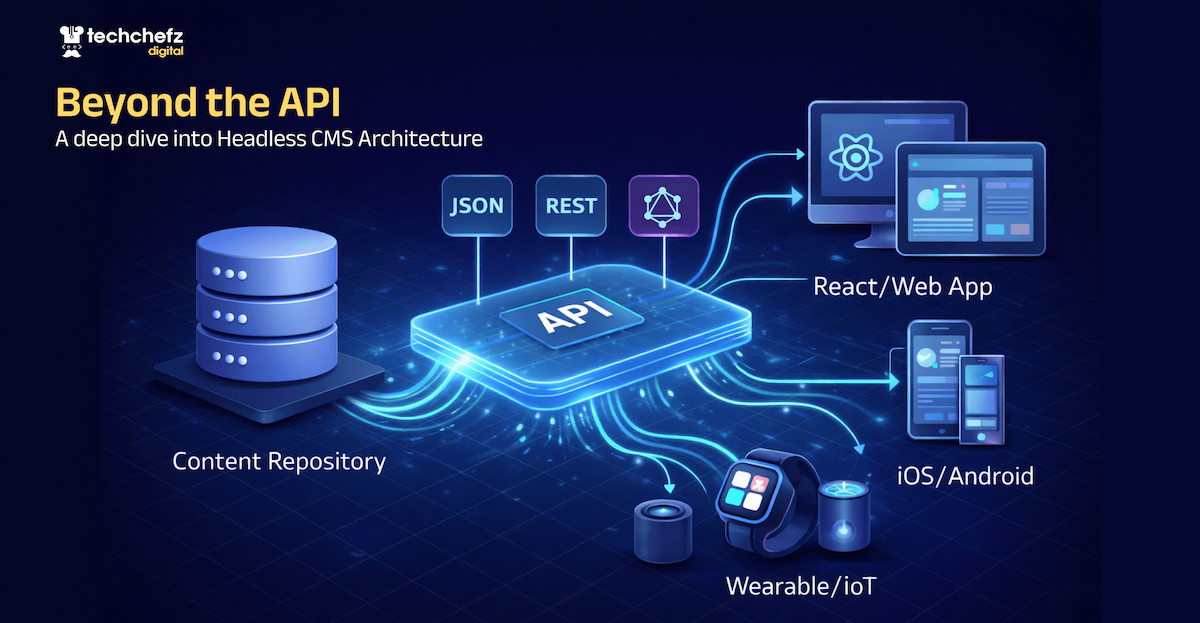
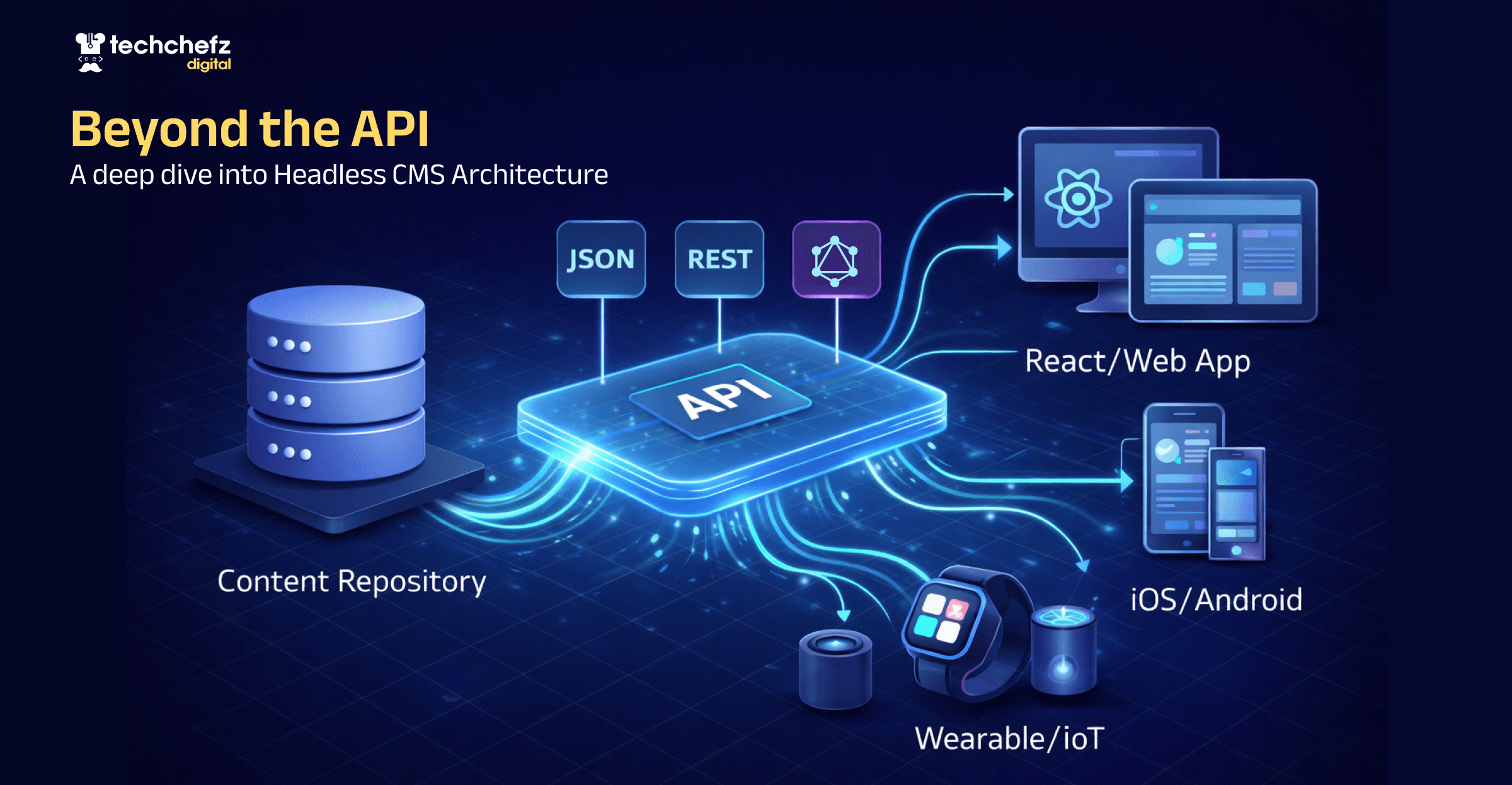
Beyond the API: A Deep Dive into Headless CMS Architecture
Published On
Feburary 6, 2026
Author
Kunal Bhardwaj
Services
Overview
Picture this: A global B2B organisation launches a new product update. The website team updates content. The mobile app team waits, Sales enablement PDFs are outdated. Partner portals show old messaging. Same product. Same company. Different versions everywhere. The problem isn’t effort. It’s architecture. This is exactly where headless CMS architecture steps in, not as a buzzword, but as a practical solution to modern content complexity.
Headless CMS Isn’t Just “CMS Without a Frontend”
Most explanations stop at this line: “Headless CMS delivers content via APIs.”
True, but incomplete.
Headless CMS is really about decoupling content from presentation, so content can move freely across systems, teams, and channels without duplication or dependency.
For B2B organisations managing:
- Multiple touchpoints
- Long buyer journeys
- Frequent content updates
What’s Actually Inside a Headless CMS Architecture
- 1. A Structured Content Core Content is created as modular, reusable pieces, not pages. That means: Product descriptions reused across web, app, and portals Case studies adapted without rewriting Updates made once, reflected everywhere This structure is what gives headless CMS its scalability.
- 2. The API Layer (The Connector, Not the Hero) APIs expose content as data, usually JSON, so any system can consume it. But APIs alone don’t solve content chaos. They simply enable distribution. The real value comes from how content is modeled and governed before it ever reaches an API.
- 3. Decoupled Frontends for Speed Frontend teams are no longer constrained by CMS templates. They can: Build faster using modern frameworks Deploy independently Optimise performance without backend dependencies For B2B platforms, this means faster launches and fewer bottlenecks between teams.
- 4. Integration & Orchestration Layer This is where headless CMS becomes enterprise-ready. Content integrates with: Analytics platforms Personalisation engines CRM and CDP systems Search and recommendation tools Content doesn’t just publish, it responds. Why API-First Alone Isn’t Enough Many platforms claim to be headless because they expose APIs. But without: Thoughtful content modeling Clear workflows and governance Performance and caching strategies Teams end up with fragmented content and inconsistent experiences.
Headless CMS vs Traditional CMS (The Practical Difference)
Traditional CMS:
- Content and frontend tightly coupled
- Slower updates
- Limited channel flexibility
-
Headless CMS:
- Content-first, channel-agnostic
- Faster delivery cycles
- Built for omnichannel growth
Why B2B Teams Are Adopting Headless CMS
Because it enables:
- Consistent messaging across long buyer journeys
- Faster go-to-market for product updates
- Better personalisation using structured data
- Future-ready expansion into new channels
Where Headless CMS Fits in a Composable Stack
Headless CMS often sits at the centre of a composable architecture, alongside:
- Commerce systems
- Personalisation platforms
- Analytics and data layers
How TechChefz Digital Helps You Go Beyond Headless
At TechChefz Digital, we don’t implement headless CMS as a feature. We design it as part of a scalable digital architecture. We help teams:
- Model content for reuse and growth
- Design headless and composable CMS architectures
- Integrate CMS with analytics, personalisation, and data platforms
- Build fast, flexible frontends aligned with business goals
Final Thought
APIs enable headless CMS.
Architecture makes it powerful.
When content is designed to move freely, across channels, teams, and experiences: headless CMS becomes more than a technical choice.
It becomes a growth enabler.
TechChefz Digital can help you design a headless architecture built for scale, speed, and long-term flexibility.
Get in touch to explore headless CMS the right way.
Unlock more insights:
https://www.techchefz.digital/insights/which-is-the-best-cms-for-your-digital-transformation-journey
https://www.techchefz.digital/insights/cms-integration-challenges--solutions-a-complete-guide-for-2026
OTHER INSIGHTS
Explore More of Our Insights









DISCOVER MORE