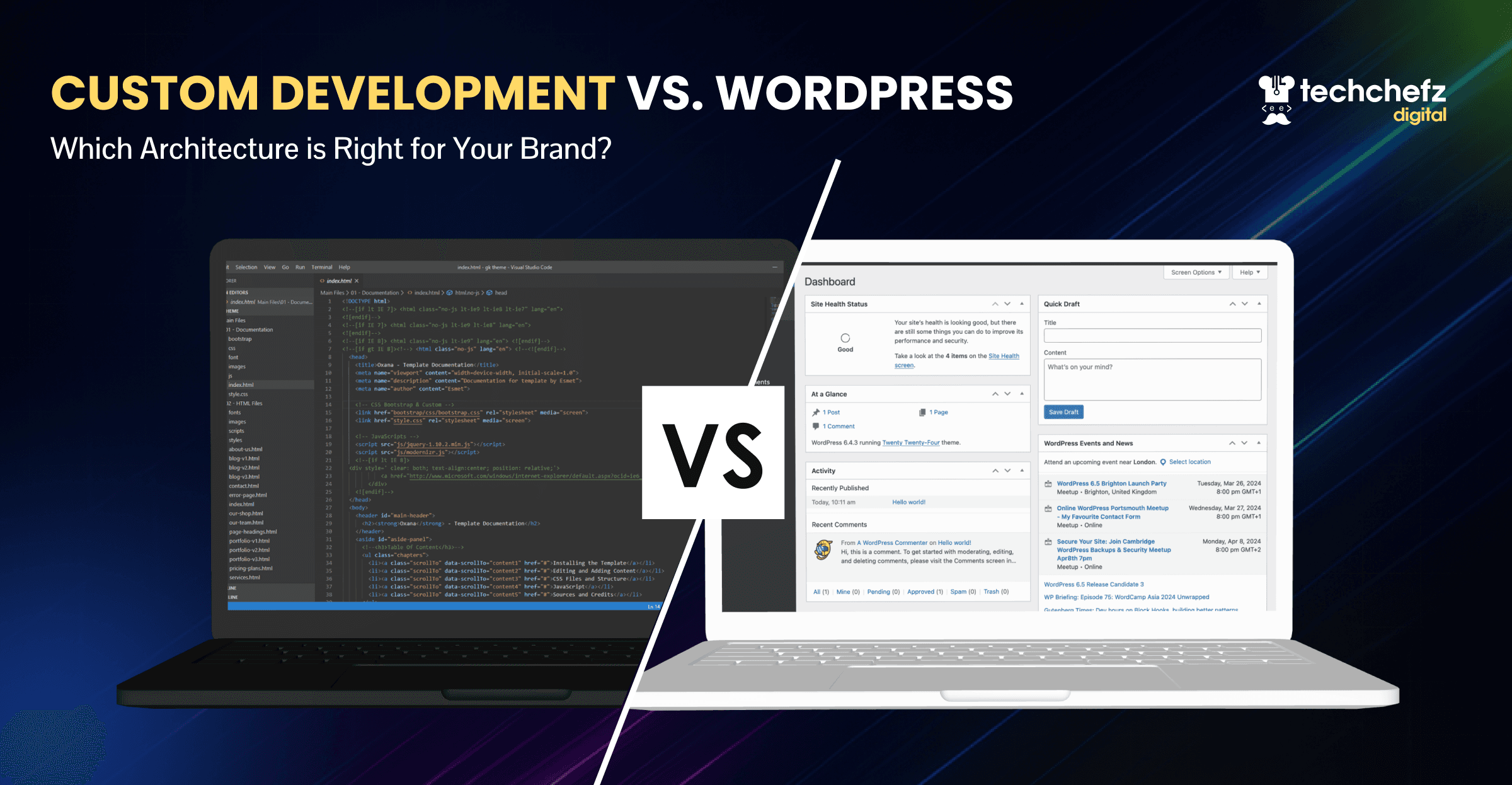
Custom Development vs. WordPress: Which Architecture is Right for Your Brand?
Published On
March 6, 2026
Author
Rahul Aggarwal
Services
Overview
Every brand moving online faces a foundational question: do we build something purpose-made, or do we use a platform that is already built? This is not just an IT decision. The platform you choose affects your load times, your security posture, your ability to scale, your ongoing costs, and the ceiling on what your digital experience can become. While WordPress powers over 43% of all websites on the internet , custom development drives the most ambitious digital products in the world. Both have earned their place. This guide breaks down the core trade-offs so you can make the right architectural call for your brand.
WordPress: The Accessible Launchpad
WordPress is an open-source content management system (CMS) that provides a pre-built framework for publishing digital content.
WordPress excels through:
- A massive plugin ecosystem of over 60,000 extensions.
- Fast time-to-market, taking a site from concept to live in days or weeks.
- Familiar interfaces that allow non-technical teams to manage content daily.
- Out of the box, sites carry performance overhead from plugin calls and database queries.
- Market dominance makes it the most targeted CMS on the internet, requiring constant security maintenance.
- Pre-built themes impose structural and layout constraints that limit unique brand expression.
But this accessibility comes with distinct trade-offs:
In other words: WordPress is the right choice when speed to market is critical and you are a content-first business. However, for complex transactional workflows or genuine enterprise scale, the architecture begins to show its seams.
Custom Development: The Strategist’s Choice
Custom development means building your digital product from the ground up, using code written specifically for your unique requirements. While it takes months to build properly, custom architecture delivers strategic advantages:
- Absolute Performance: Systems built on modern frameworks (like Next.js or Nuxt) have no plugin overhead and are optimized by design.
- Security by Design: A custom application inherently has a smaller attack surface because attackers lack pre-existing knowledge of the architecture.
- Limitless Scalability: The database architecture and API design are engineered specifically for your traffic profile and growth trajectory.
- Unconstrained Design: Your design team gets a blank canvas, ensuring your visual identity is fully expressed without template limitations.
This means: Custom development is a requirement when your digital experience is a primary competitive differentiator. While the upfront investment is higher, a well-built custom system often results in a lower total cost of ownership (TCO) over five years compared to a complex WordPress stack.
The Third Option: Headless WordPress
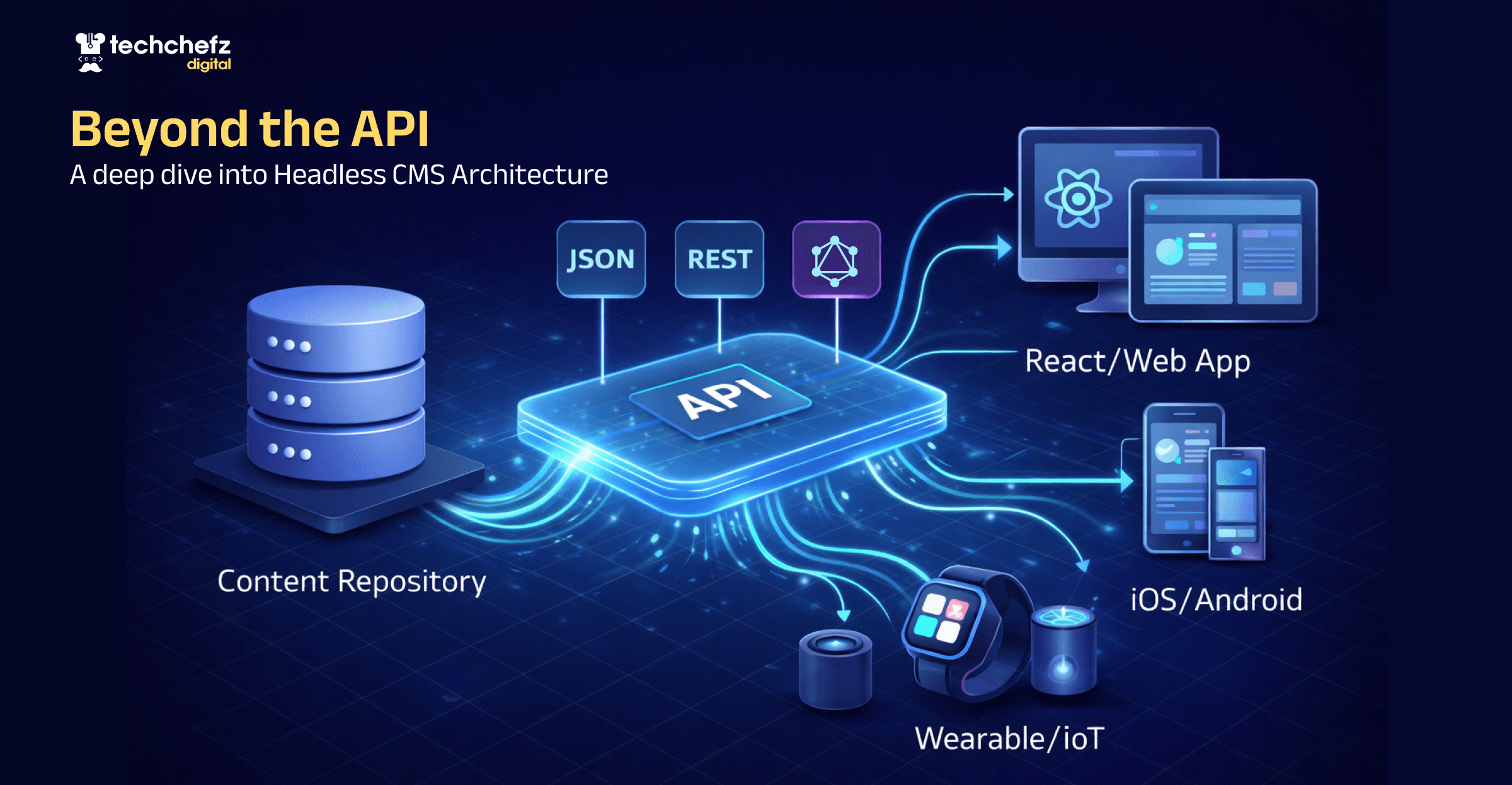
If you find yourself torn between the two, there is a compelling middle path: headless architecture. In a headless model:
- WordPress operates strictly as a backend CMS, handling content management and editorial workflows.
- A custom-built frontend (typically using a framework like Next.js) handles the user experience, delivering high performance and total design flexibility.
Side-by-Side: Architecture Comparison
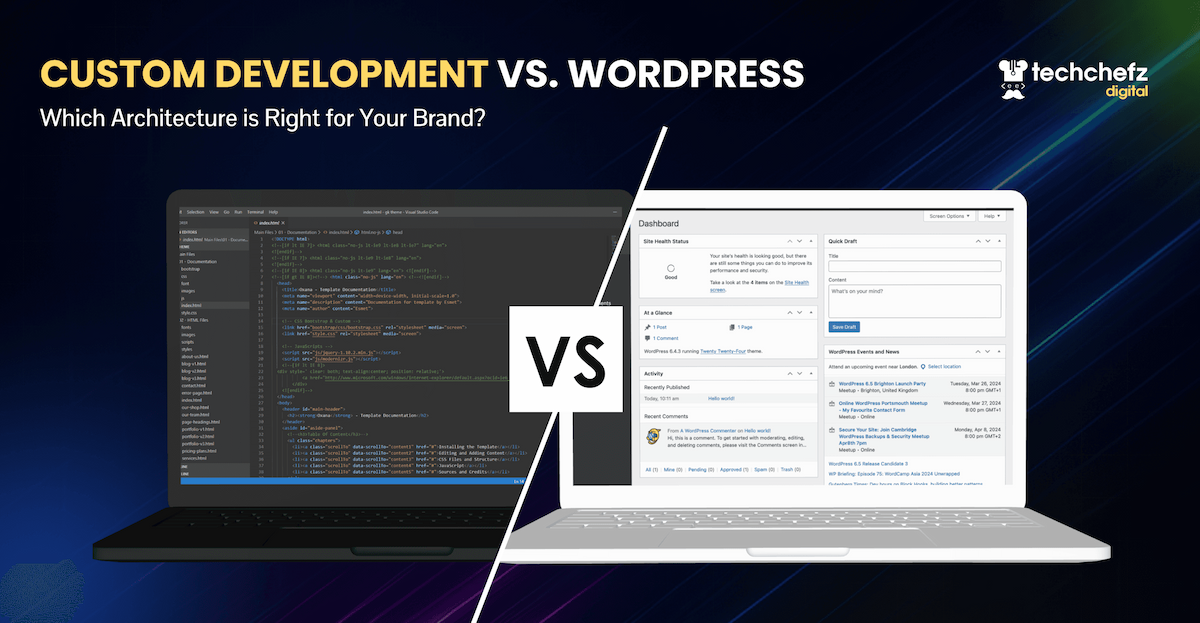
- Speed to Launch: Custom development takes weeks to months, while WordPress can be launched in days to weeks.
- Design Flexibility: Custom development offers complete creative freedom, whereas WordPress is template-constrained.
- Performance: Custom architectures are optimised by design, while WordPress relies on managed overhead.
- Security Profile: Custom builds present a smaller attack surface, whereas WordPress is a high target, manageable system.
- Scalability: Custom development is built for your scale, while WordPress is strong up to a point.
- Initial Cost: Custom development requires a higher investment, compared to the lower starting cost of WordPress. while WordPress is strong up to a point.
- Long-term TCO: A good custom build yields a lower long-term cost, whereas WordPress involves ongoing maintenance costs.
Final Thought: Choose Your Growth Foundation
Neither architecture is universally superior. The right answer depends entirely on what your brand needs to accomplish, the resources available, and the timeframe you are working to.
The worst outcome is not choosing the wrong platform. It is choosing without understanding the trade-offs and building a constraint into your brand before you have had a chance to grow.
Not sure which architecture is right for your brand? At TechChefz Digital, we help businesses make the right architectural decision before a single line of code is written — and build digital products that deliver measurable results at any scale.
→ Connect with TechChefz Digital | www.techchefz.com
OTHER INSIGHTS
Explore More of Our Insights
































DISCOVER MORE