Why Context-Powered Data Is the Secret Ingredient for Intelligent AI in 2026
Published On
January 29, 2026
Author
Rahul Aggarwal
Services
Overview
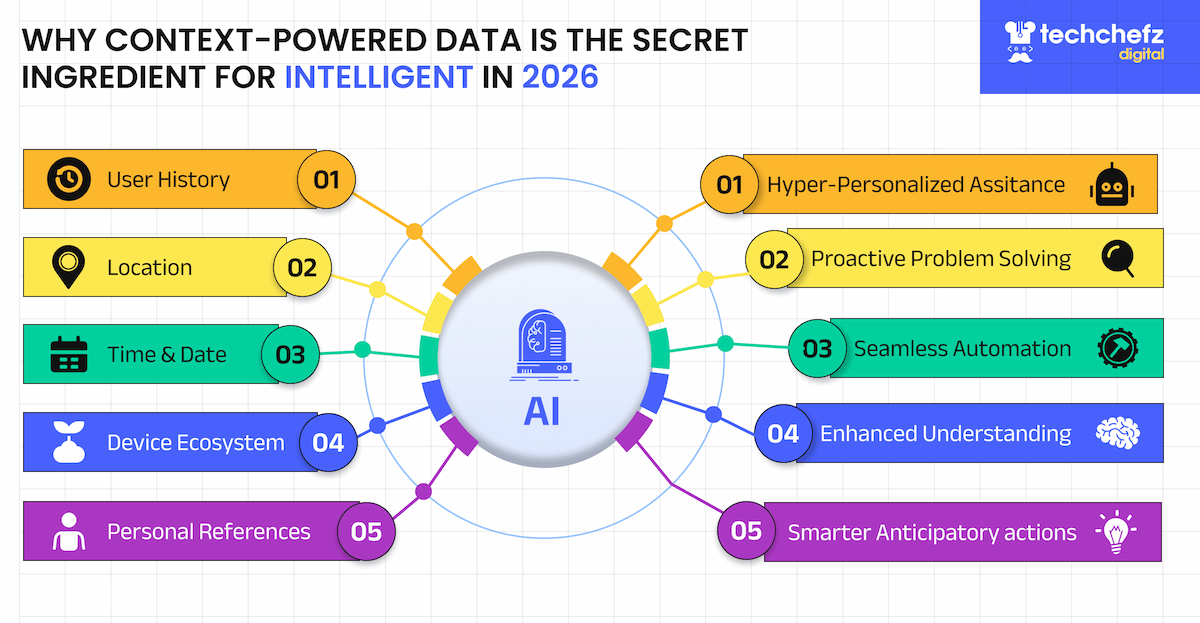
AI is everywhere, generating text, summarizing reports, automating tasks, and accelerating workflows. But there’s a hidden truth most teams discover only after their first AI rollout: AI doesn’t truly understand your business unless it understands your data first. The difference between good AI and meaningful AI isn’t the model you use, it’s the data foundation that feeds it.
The Data Problem That Slows AI Down
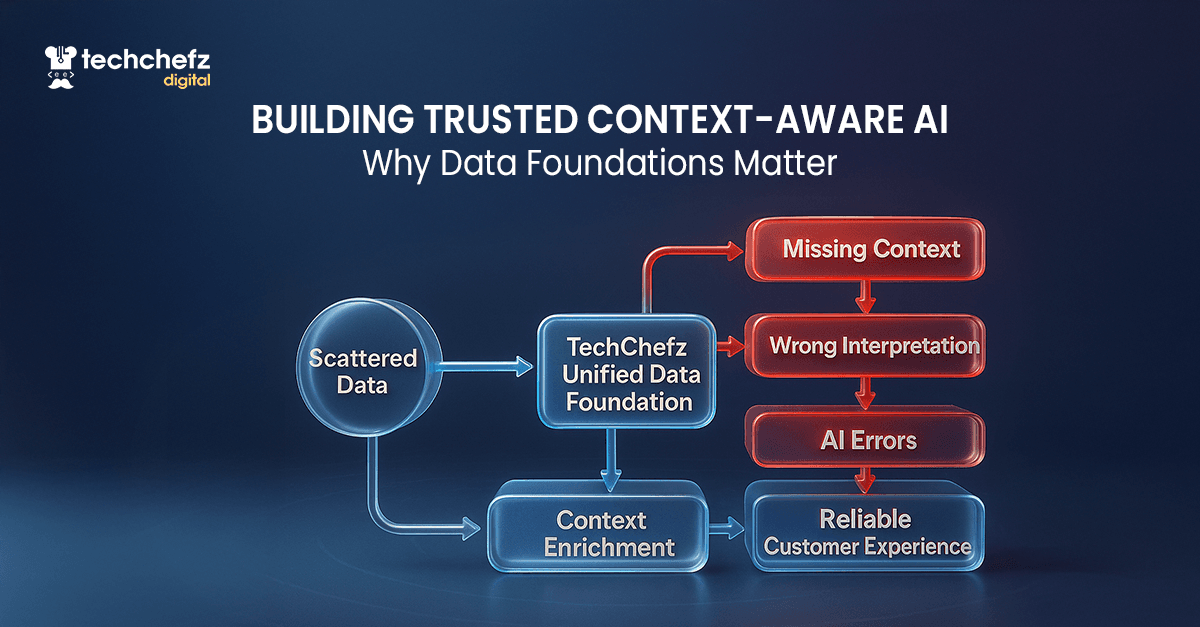
Before we can talk about smart AI, we need to admit something uncomfortable: Most organisations today have lots of data, but not connected, contextual, and clean data. Why does this matter? Because when AI systems try to act, not just generate they need:
- A single source of truth
- Real-time context from multiple systems
- Governing rules baked into data access
- Clean signals that reduce noise and incorrect decisions
If your data is siloed, inconsistent, outdated, or fragmented, even the smartest AI does nothing more than guesswork. This is why agentic AI, the next wave of AI that doesn’t just respond but acts, requires more than algorithms. It needs high-quality, unified data.
What AI Does with Bad Data vs Good Data
With Poorly Connected Data: AI might:
- Generate irrelevant answers
- Misinterpret context
- Deliver inconsistent results
- Repeat information instead of acting on it
Imagine a customer support agent AI that can answer questions — but doesn’t know the customer’s purchase history, support tickets, or loyalty status. The result? Generic responses and frustrated users.
With Clean, Connected, Contextual Data: AI can:
- Understand the complete business story
- Link customer history with real behaviour
- Act autonomously across systems
- Make decisions that align with operational rules
- Trigger workflows without human prompting
That’s the moment AI stops being a tool and becomes a trusted digital decision-maker.
To power the next generation of AI, especially agentic AI — your data must be:
- 1. Clean No duplicates. No conflicts. No outdated records. AI agents rely on accurate facts; noise or errors create poor decisions and hallucinations.
- 2. Connected Data from CRM, ERP, support systems, analytics platforms, products, and external sources must be unified into a single view. Only connected data gives AI the full story.
- 3. Contextual Context means adding meaning — customer status, business rules, time-sensitive signals, and relationships between entities.
Why Traditional Data Isn’t Enough
Legacy data systems were built for reporting or static analysis, not real-time decision-making.
AI agents powered by models like LLMs can interpret language and generate responses, but they need structured, governed, real-time data to act with confidence.
This is where modern data strategies like unified data layers, real-time ingestion, and governed customer profiles become non-negotiable.
When agents operate on trusted real-time data, they can:
- Personalise experiences without manual intervention
- Execute multi-step processes autonomously
- Provide real-time operational insights
- Apply business rules consistently
- Reduce risk and increase trust in AI outcomes
Real-World Wins: What AI Agents Can Do with Great Data
With the right data foundation, agentic AI becomes a business advantage, enabling workflows like:
- Real-Time Decisioning AI agents can pull live data from multiple systems — CRM, finance, product, support — to make contextual decisions in seconds, not hours.
- Hyper-Personalised Engagement Instead of generic responses, AI can tailor interactions based on real customer history and preferences.
- Automated Process Orchestration AI can autonomously coordinate multi-system processes such as order changes, billing adjustments, or service escalations without human handoffs.
- Adaptive Risk Mitigation With reliable data and consistent governance, AI agents can flag anomalies, enforce policies, and reduce errors in real time.
What This Means for Your Business in 2026
By 2026, the organisations that outperform competitors won’t be those who use AI — they’ll be the ones whose AI understands context and acts autonomously. This is the shift from:
- Having data → to using data
- Generating output → to driving outcomes
- Manual decisions → to AI-assisted decisioning
How TechChefz Digital Can Help
At TechChefz Digital, we partner with organisations to build future-ready AI foundations that go beyond experimentation and deliver measurable business value. We help:
- Design unified, clean, governed data architectures
- Enable real-time data connectivity across systems
- Build AI-ready platforms that deliver contextual intelligence
- Implement autonomous AI agents that act with mission-critical accuracy
OTHER INSIGHTS
Explore More of Our Insights































DISCOVER MORE