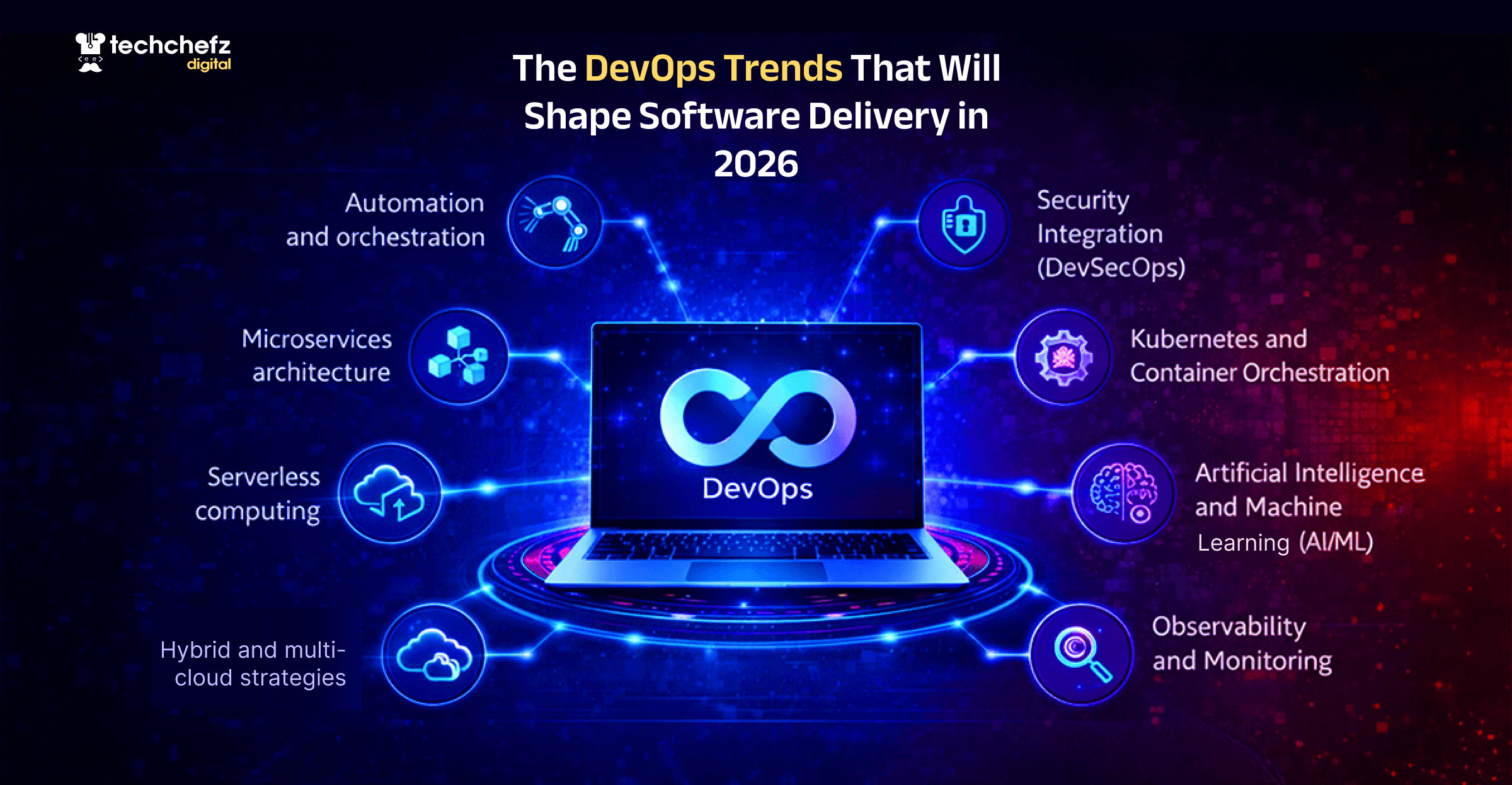
The DevOps Trends That Will Shape Software Delivery in 2026
Published On
January 15, 2026
Author
Kunal Bhardwaj
Services
Overview
Imagine this.
A bug appeared in production at 2:17 AM.
Before a human even opens Slack, an AI system has already detected the anomaly, traced the faulty service, rolled back the release, and rerouted traffic, all in seconds.
By morning, customers never even knew something went wrong.
This isn’t science fiction.
This is what DevOps in 2026 will look like.
The days of manually monitoring dashboards, chasing alerts, and scrambling during outages are coming to an end. DevOps is evolving from a pipeline into a self-thinking, self-healing delivery engine.
Here’s what’s driving that shift.
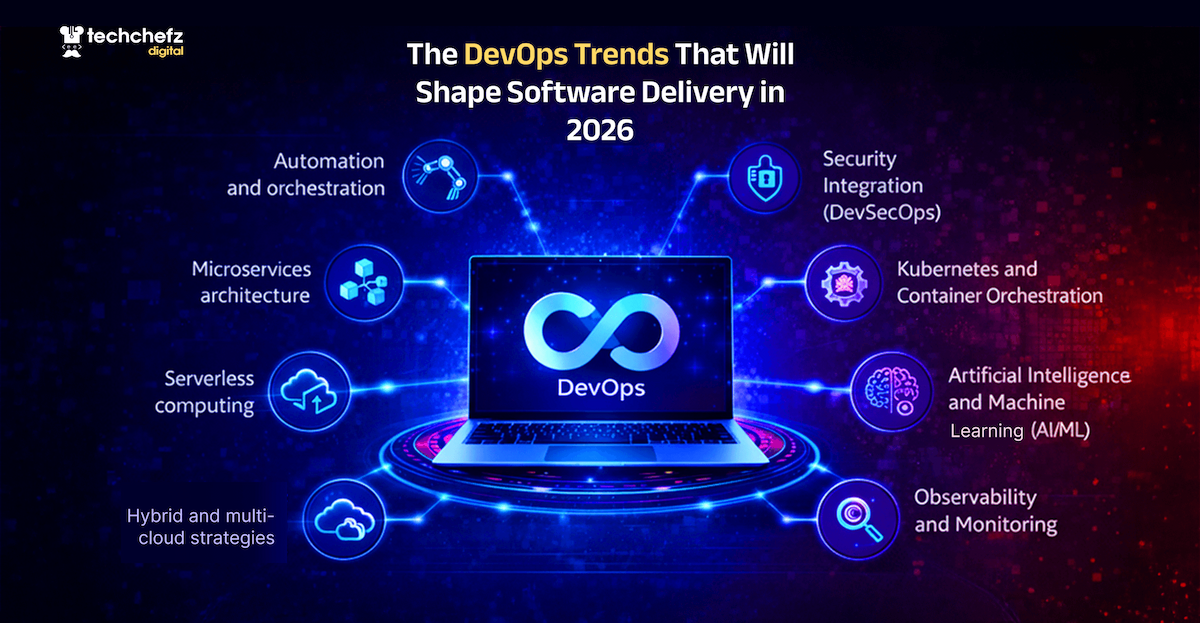
1. AI Is Becoming the Brain of DevOps
DevOps has always been data-heavy. Logs, metrics, traces, incidents, it’s a flood of signals.
In 2026, AI becomes the layer that finally makes sense of it all.
Instead of teams reacting to alerts, AI systems will:
- Predict failures before they happen
- Detect abnormal behaviour across thousands of services
- Suggest or execute fixes automatically
- Optimise cloud resources in real time
2. From Automated to Autonomous Delivery
Automation executes tasks. Autonomy makes decisions. That’s the leap happening in DevOps. By 2026, pipelines will:
- Decide when a release is safe
- Choose how much testing is needed
- Roll back risky deployments automatically
- Adjust traffic during incidents
3. Security Becomes Built-In, Not Bolted-On
The speed of modern software has exposed a hard truth: security cannot sit at the end of the pipeline anymore. DevSecOps will become the default in 2026:
- Security policies coded into pipelines
- Vulnerabilities detected during build
- Compliance checks running continuously
- Runtime protection guarding live systems
4. Cloud-Native Is No Longer Optional
Software in 2026 will be:
Distributed, Event-driven, API-first and Built on microservices and serverless.
DevOps teams will manage not just servers, but living ecosystems of services that scale and change in real time.
This requires advanced observability, service meshes, and intelligent traffic management — because when everything is connected, everything must be visible.
5. Platform Engineering Will Power Developer Experience
As DevOps stacks grow more complex, many companies are building internal platforms that give developers: Ready-to-use pipelines Secure environments Standardised tools Built-in compliance This is platform engineering — turning DevOps into a product. Instead of every team reinventing the wheel, developers get everything they need to ship fast without breaking things. In 2026, the best developer experience wins.
What This Means for Teams Today
The future of DevOps isn’t about adding more tools. It’s about building intelligent, connected, and resilient delivery systems. Teams that modernise will:
- Ship faster
- Fail less
- Recover instantly
- Innovate continuously
How TechChefz Digital Helps You Get There
At TechChefz Digital, we help organisations build DevOps platforms designed for this new era — where AI, cloud, security, and automation work together.
We support:
AIOps and intelligent pipelines
Cloud-native DevOps architecture
DevSecOps frameworks
CI/CD modernisation
Platform engineering for developer teams
We don’t just help you deploy.
We help you evolve how you deliver.
Ready for DevOps that’s built for 2026?
Let’s design a software delivery engine that scales with your business, not against it.
Talk to TechChefz Digital and start building the future of DevOps.
📩 [email protected]
🔗 www.TechChefz.digital
OTHER INSIGHTS
Explore More of Our Insights









































DISCOVER MORE