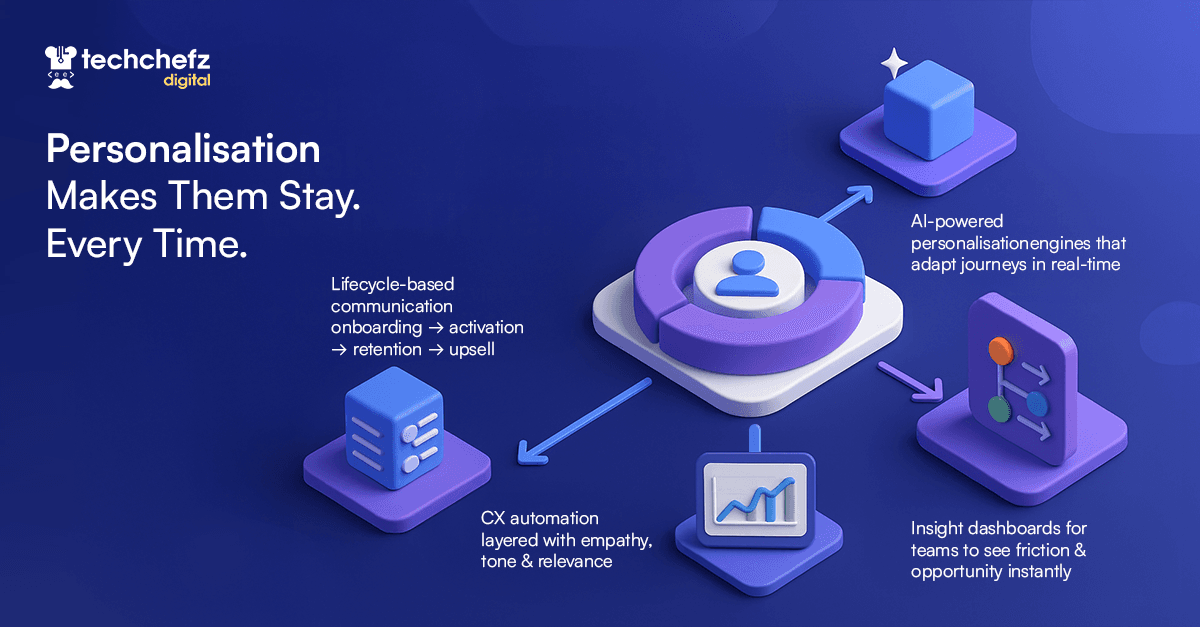
Personalisation Makes Them Stay. Every Time.
Published On
December 11, 2025
Author
Kunal Bhardwaj
Services
Overview
Customers rarely leave because of a single issue.
They leave because the journey never felt personal enough to stay.
A product can be excellent.
Pricing can be competitive.
Support can be fast.
Yet none of it matters if the experience feels generic.
The truth is simple: people don’t stay where they feel unseen.
And in an age of overwhelming choice, feeling “seen” is the most undervalued competitive advantage.
Personalisation isn’t a decorative layer on top of customer journeys.
It is the foundation that turns interest into engagement, usage into adoption, and customers into long-term loyalists.
Why Personalisation Matters More Than Ever
Most organisations still treat personalisation as a marketing convenience—something that helps conversion, not something that shapes the entire experience.
But data tells a different story.
Global reports show that companies who invest deeply in personalisation generate significantly more revenue and loyalty than those who don’t. Meanwhile, businesses relying on generic communication face higher drop-offs, slower onboarding, and declining retention.
When personalisation is missing, customers feel like they’re navigating a system—not a relationship.
When personalisation is present, the experience becomes intuitive, relevant, and worth returning to.
Where Personalisation Breaks Down Today
Despite access to customer data, analytics, and automation tools, many brands still struggle to deliver meaningful personalisation. Common challenges include:
- 1. Fragmented Data Across Teams Sales, support, and product systems often operate in isolation. Without a unified view, the customer receives inconsistent or repetitive interactions.
- 2. Static Journeys That Don’t Adapt Everyone receives the same onboarding emails, the same nudges, the same messages—regardless of their behaviour or stage of maturity.
- 3. 3. Conversations Without Memory Customers repeatedly explain their history. Preferences and pain points go unnoticed. Patterns are overlooked.
- 4. Personalisation Stops After Acquisition The moment the deal is closed, communication becomes generic. But the most critical personalisation happens after the sale—during adoption, renewal, and expansion. These gaps are not minor. They’re often the exact reason loyalty weakens and customers quietly drift away.
What Real Personalisation Looks Like
Real personalisation is not about name tags, segmentation, or templates. It’s about recognition, relevance, and timing.
- 1. Behaviour-led experiences Journeys shift based on how the customer behaves, not on preset sequences.
- 2. A unified customer profile Every interaction—across product, support, sales, and communication—feels consistent because every team sees the same complete story.
- 3. AI-powered prediction and automation AI identifies friction before the customer articulates it, enabling brands to act proactively, not reactively. When done well, personalisation makes the experience feel effortless. And effortlessness is what keeps customers coming back.
The Impact You Can Expect
At TechChefz Digital, we see Martech not as a collection of tools, but as a digital nervous system — where every signal, touchpoint, and action feeds into smarter experiences. Our approach focuses on building experience-first ecosystems: When brands commit to deep personalisation, the results are measurable:
- Higher adoption and product usage
- Lower support ticket volume
- Stronger renewal and retention rates
How TechChefz Digital Helps Brands Make Personalisation Real
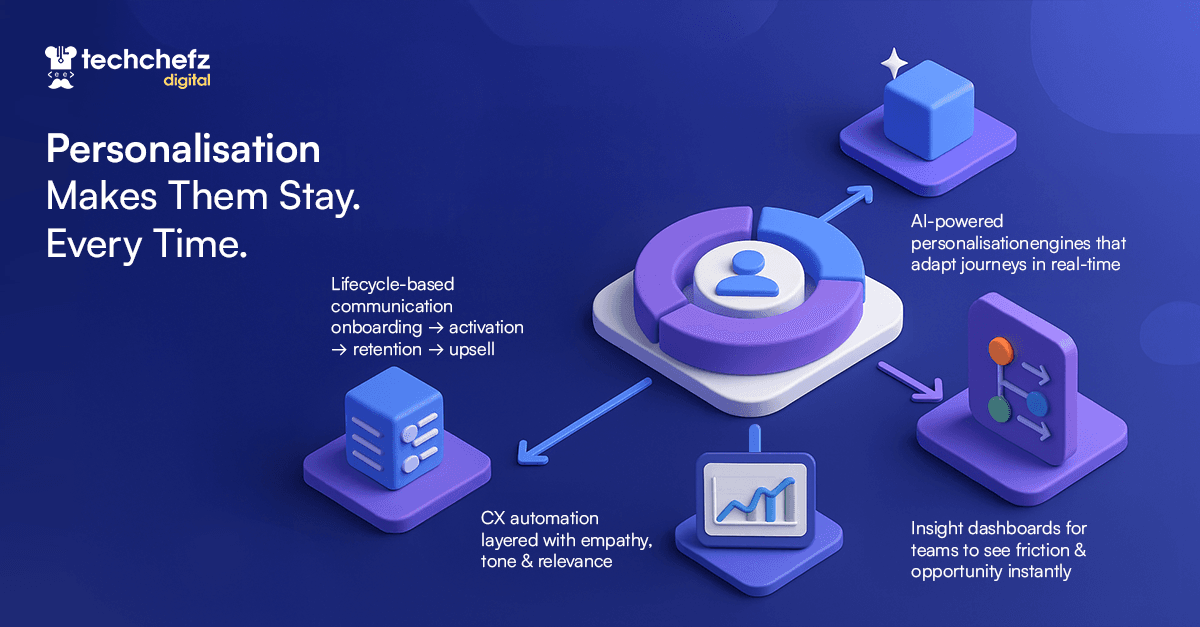
At TechChefz Digital, we help organisations move beyond basic segmentation into intelligent, lifecycle-based personalisation powered by a unified customer view and AI-driven orchestration. Our approach includes:
- 1. Unified Customer Intelligence Platforms We consolidate data across tools, channels, and touchpoints to build a real-time, 360-degree profile of every customer.
- 2. Behaviour-Responsive Journeys We design adaptive journeys that shift dynamically based on customer actions, needs, and friction points.
- 3. AI Personalisation Engines Our AI models predict customer behaviour, recommend next-best actions, and deliver timely interventions that improve satisfaction and retention.
- 4. Lifecycle Automation Architecture We optimize onboarding, activation, usage, renewal, expansion, and re-engagement flows with contextual messaging at every stage.
- 5. Experience Insights Dashboards Teams gain visibility into journey drop-offs, adoption gaps, sentiment trends, and retention drivers—supporting better decision-making.
With this foundation, we’ve enabled brands to improve retention, accelerate growth, and transform fragmented journeys into connected experiences that customers value and remember. Because when experiences feel personal, customers don’t just convert—they stay.
OTHER INSIGHTS
Explore More of Our Insights
















DISCOVER MORE