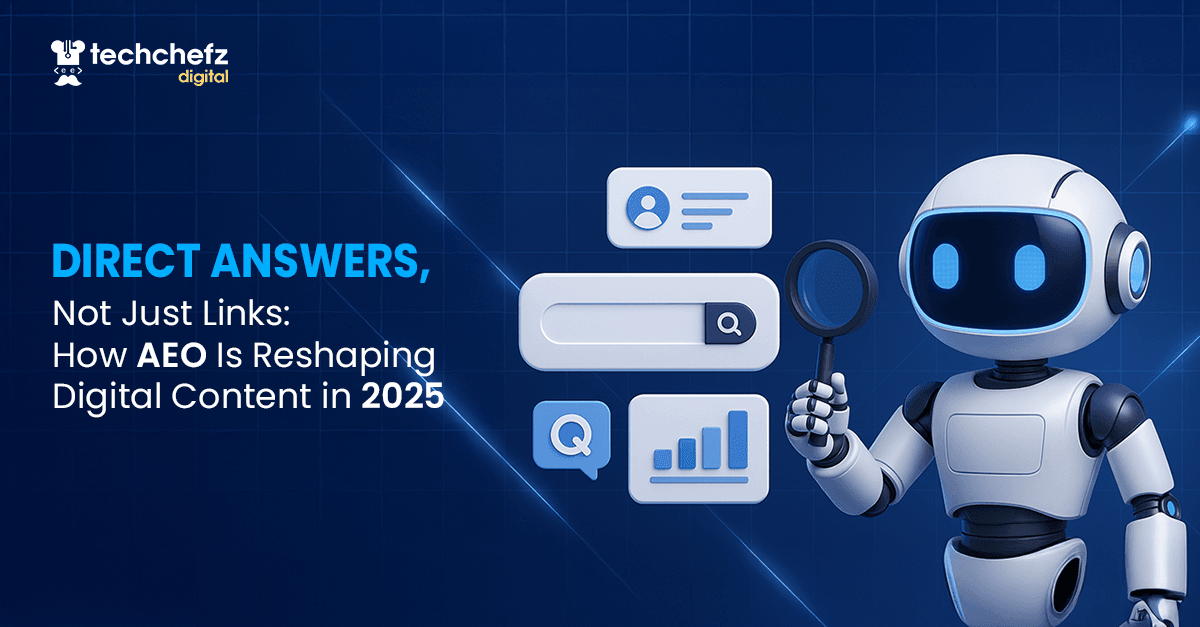
Direct Answers, Not Just Links: How AEO Is Reshaping Digital Content in 2025
Published On
September 26, 2025
Author
Kunal Bhardwaj
Services
The Silent Revolution in Search
In 2025, a quiet revolution is underway. Search is no longer about pages; it's about answers. AI answer engines—ChatGPT, Gemini, Google AI Overviews—are rewriting the rules. Where SEO once competed for clicks, Answer Engine Optimization (AEO) competes for mentions, citations, and trust in AI responses.
Old tactics — keyword stuffing, backlink hustling, meta tags — won’t cut it anymore. The stakes are different now: your content must be machine-readable, semantically rich, and inherently trustworthy. And that means rethinking your digital content in fundamental ways.
Understanding AEO: What It Is & Why It Matters
Answer Engine Optimization (AEO) is the practice of optimizing content so that AI-driven systems deliver your material as the direct response to user queries—without requiring a link click. Instead of sending users to a page, the engine gives them your answer first.
What makes AEO different from traditional SEO?
- Zero-click search becomes the norm—many queries end without any link being clicked.
- Featured snippets optimization, voice search answers, and Google AI Overviews become primary real estate.
- Semantic search and conversational search optimization matter more than raw keywords.
- Success is measured not by rankings, but by AI-powered content answers and how often your content is cited as the answer.
Building Content for the Answer Era
Optimizing for AEO is not about shortcuts—it’s about architecture, clarity, and credibility. Here’s what works:
- Structuring for clarity Use Q&A formats, FAQs, headings with questions, and schema markup. AI engines are drawn to clearly signposted content—they can parse it more confidently.
- Conversational voice + intent matching Your content should mirror how people speak—“How do I …?”, “What’s the best …?”, “Why does … happen?” AI engines favor this natural tone.
- Authority & credible sourcing You earn trust by citing reputable sources, linking to studies, and signaling your expertise. AI systems tend to prefer content with backing.
- Freshness & maintenance Update content regularly. AI engines may re-evaluate whether your content remains relevant, especially for topics that evolve.
- Technical readiness Use structured data (FAQ schemas, how-to markup), ensure your content is crawlable, and optimize for speed and mobile. AI engines still rely on these signals.
AEO in Action: Real Examples Across Industries
- Tech / SaaS: A company publishes a detailed “What is AEO?” Q&A page. When users ask ChatGPT “What does AEO mean in SEO?”, that page is quoted verbatim in the response—driving qualified traffic and brand authority into the funnel.
- Healthcare: A medical clinic writes clear, evidence-backed FAQ content on common symptoms. When AI engines respond to symptom queries, the clinic is cited, building trust and awareness before a user ever clicks./li>
- E-commerce: A brand optimizes its product pages with Q&A structured sections, capturing voice search traffic. When users say, “What’s the best wireless earbuds under $200?”, their product is featured in the AI response.
Lessons From GEO: Reinforcing the Strategy
If you’ve followed our coverage of GEO (Generative Experience Optimization), you’ll see clear overlaps. GEO is about optimizing content so AI generative systems cite you in their synthesis. In that sense, GEO and AEO are two sides of the same coin.
To really future-proof content, brands need to treat traditional SEO, GEO, and AEO as complementary pillars. Dive deeper into how GEO rewrites SEO’s rulebook in our piece “Rethinking Search: How GEO Is Rewriting SEO’s Rulebook”
Also explore: “SEO Unleashed: Navigating the Digital Landscape with Advanced Search Engine Optimization Tools” for tools you can use today.
Measuring Success: New KPIs for AEO
The old metrics—impressions, CTR, average position—are still useful, but insufficient. AEO demands new benchmarks:
- AI Citation Rate: How often is your content used as an answer?
- Voice Search Share: How many voice queries pick your content?
- Zero-Click Visibility: How often do AI engines answer with your content, without sending clicks?
- Answer-to-Click Ratio: From an AI answer, how many users click through for more?
- Feedback Signals: When AI answers include “source” links, are users trusting your content?
These metrics allow you to optimize not just for visibility, but for being the answer.
The Shift Isn’t Optional—It’s Inevitable
AEO isn’t a trend you can test later. As AI becomes the default interface for search, only those who adapt will survive. The formula is simple yet stark:
- Continue optimizing for SEO? You’ll rank links.
- Invest in AEO/GEO strategies? You’ll become the answer.
In 2025, digital content must be engineered not just for human consumption—but for how machines think, synthesize, and deliver.
At TechChefz Digital, we’re shifting our playbook. We help brands go beyond traditional SEO to answer-first architectures. That means building conversational content, structured data layers, AI integration strategies, and audit-ready trust frameworks.
Our belief: in the AI era, your content must be answerable, not just findable—and we’re helping clients get there.
👉 Want to dive deeper into how this works? Get in touch: 📩 [email protected] 🔗 www.techchefz.digital
OTHER INSIGHTS
Explore More of Our Insights












































DISCOVER MORE