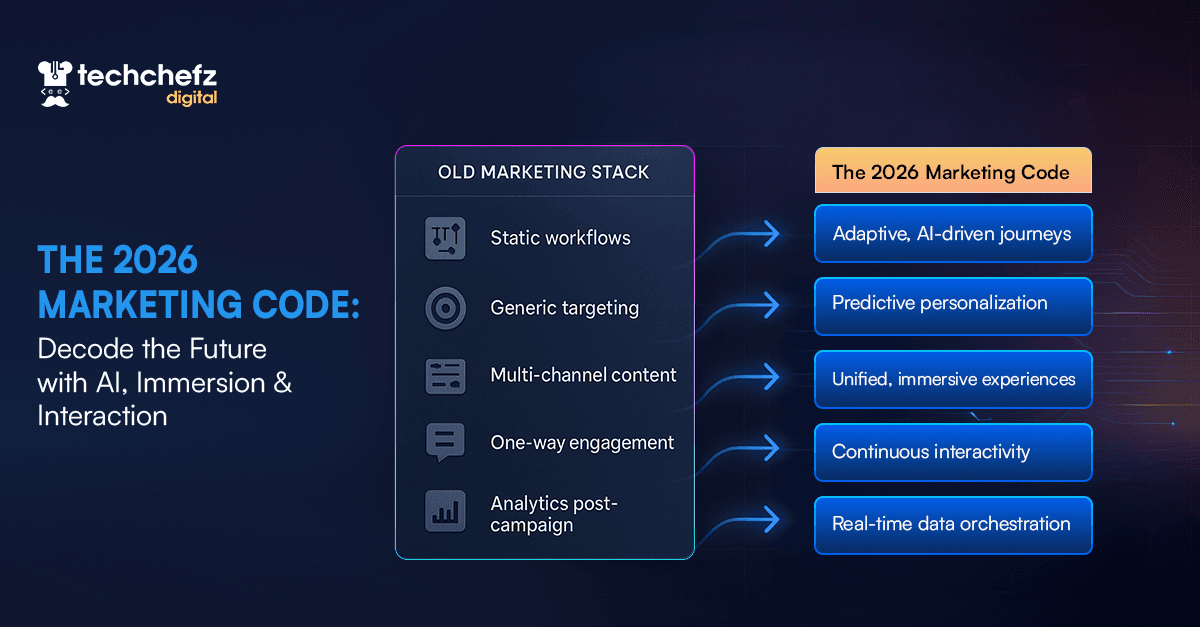
The 2026 Marketing Code: Decode the Future with AI, Immersion & Interaction
Published On
October 30, 2025
Author
Kunal Bhardwaj
Services
Welcome to the Age of Convergence
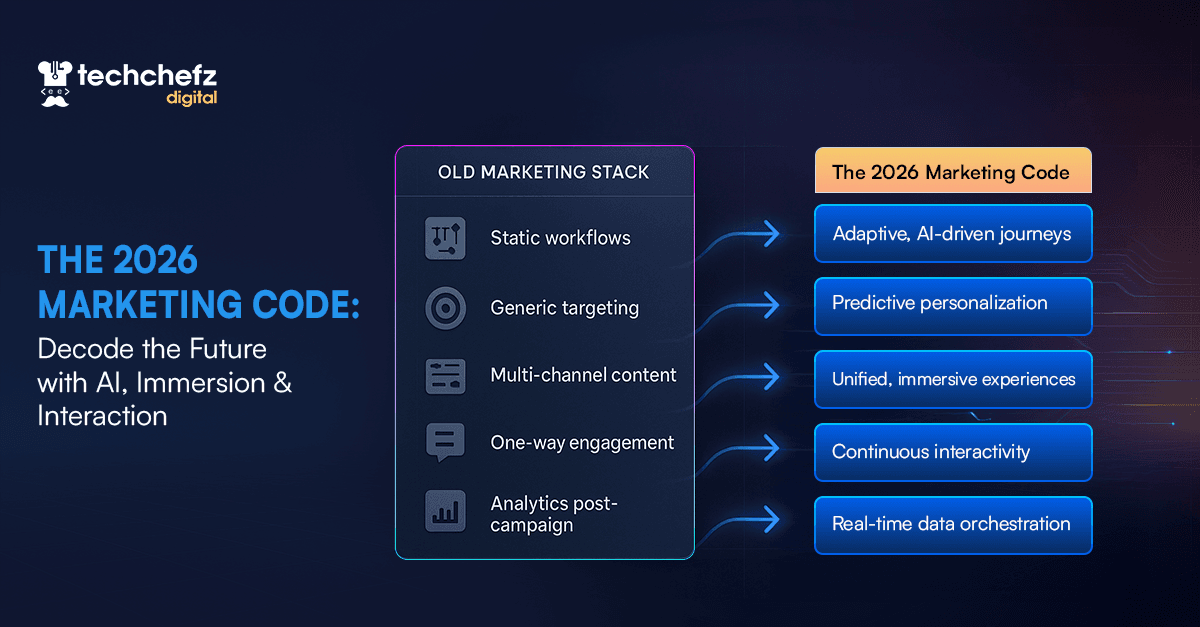
2026 isn’t just another year in digital marketing — it’s the year data, design, and delivery finally converge. AI has matured from predictive analytics to creative collaboration. AR/VR has evolved from experimental novelty to mainstream utility. And interactive content has shifted from optional engagement to the core of user experience. Together, these three forces — AI, Immersion, and Interaction — form what we call The 2026 Marketing Code: “A system where intelligence meets experience, and technology finally feels human.” The solution lies in API Harmony—a structured approach to building unified platforms that connect systems, enable faster decision-making, and support next generation enterprise agility. Through well-designed APIs, enterprises can transform fragmented ecosystems into cohesive, adaptable environments. But it’s not just about speed. The real story is how generative AI in content is forcing enterprises to rethink the very structure of their marketing and content strategies. This isn’t another tool in the marketer’s stack; it’s a paradigm shift.
AI Marketing 2.0 — From Automation to Anticipation
For the last decade, automation defined marketing.
In 2026, anticipation defines it.
AI no longer waits for inputs — it predicts them.
Take Netflix’s content recommendations or Spotify’s personalized playlists — both use predictive AI models that don’t just react to user behavior; they forecast it.
Now imagine that level of foresight in your marketing ecosystem:
- Campaigns that adjust messaging in real-time.
- Email journeys that rewrite themselves based on sentiment.
- Websites that morph to fit a user’s emotional intent.
Immersive Storytelling — When Reality Becomes the Brand
AR and VR aren’t just for gaming anymore. They’re reshaping the very definition of brand experience. By 2026, immersive marketing has become a central strategy for customer engagement — especially in retail, real estate, automotive, and luxury. When consumers “enter” a campaign instead of viewing it, retention skyrockets.
- IKEA’s AR app now lets users visualize furniture in their homes before buying.
- Nike’s virtual showrooms let customers customize sneakers in 3D and “wear” them via AR filters.
- BMW uses mixed reality test drives, blending real motion with virtual landscapes.
Hyper-Interactive Content — Turning Attention into Action
We’ve entered the age of two-way marketing. Audiences don’t just consume — they co-create. From polls and shoppable reels to dynamic video paths, interactivity now drives conversion as much as storytelling.
- LinkedIn’s interactive polls regularly generate 10× more engagement than static posts.
- Adidas’ “Choose Your Style” campaign lets users swipe through storylines that tailor product suggestions.
- Interactive videos from HubSpot deliver 2× higher completion rates than traditional content.
The New Marketing Architecture — Intelligence × Experience
To decode the 2026 marketing code, brands must evolve from fragmented tools to connected ecosystems. When AI, AR/VR, and interactive systems integrate, marketing stops being campaign-driven and becomes continuously experiential. This shift isn’t about replacing creativity with code — it’s about scaling creativity through intelligence.
Designing Experience Systems for the Future
At TechChefz Digital, we believe the future of marketing lies at the intersection of automation, data, and design. Through our expertise in AEM, AI-driven content systems, and digital experience architecture, we help enterprises:
- Build unified content supply chains powered by intelligence.
- Accelerate personalization through real-time orchestration./li>
- Deliver multi-channel experiences that learn and evolve.
The Code Is Written, But the Future Is Yours
2026 will not be the year of more tools — it will be the year of more connected experiences. The brands that lead will be those that treat marketing not as a funnel, but as a living system.
Automation got us here.
Intelligence will take us forward.
Is your organization ready to decode the 2026 marketing code?
Get in touch with TechChefz Digital and discover how we’re helping enterprises craft intelligent, personalized, and scalable experiences.
📩 [email protected]
🔗 www.TechChefz.digital
OTHER INSIGHTS
Explore More of Our Insights




DISCOVER MORE