Generative AI: From Experiments to Enterprise Solutions
Published On
July 24, 2025
Author
Kunal Bhardwaj
Services
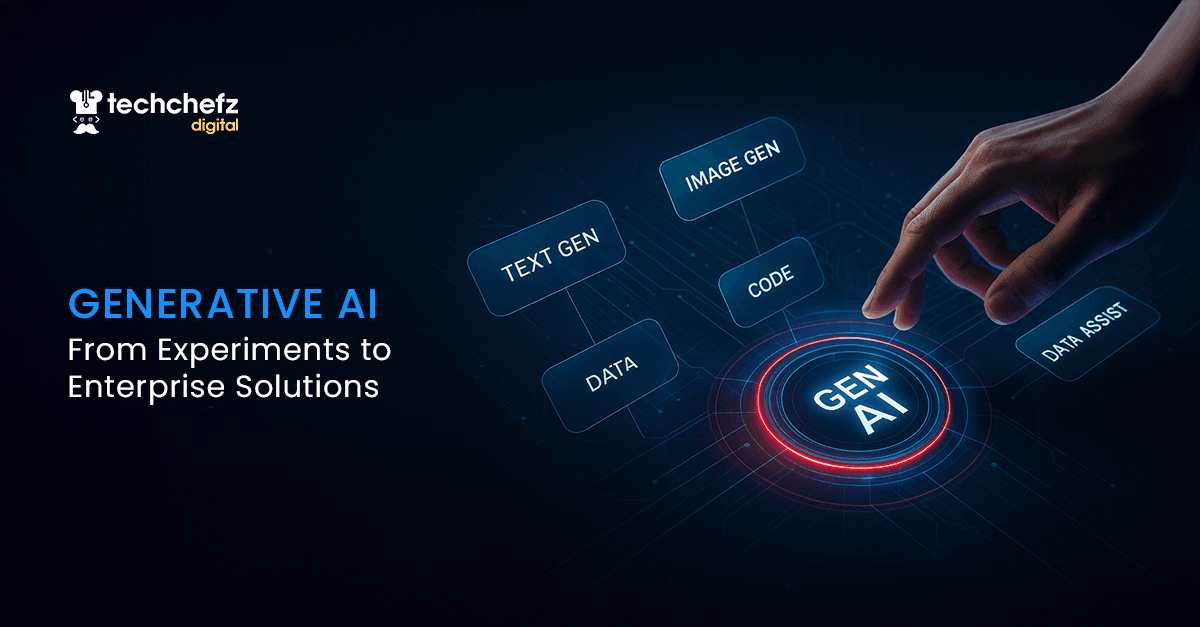
Generative AI Is No Longer Just a Buzzword
What started as experimental AI models generating quirky poems or synthetic images has now become a strategic cornerstone for modern enterprises. Generative AI has matured from the labs of researchers into boardrooms, customer support systems, product development cycles, and marketing teams. Today, businesses are not just exploring generative AI, they’re building with it. The focus has shifted from “Can we do this?” to “How fast and how effectively can we scale this?"
Phase 1: The Experimental Era
In its early stages, generative AI was largely academic or hobbyist. Models like GPT-2 and early GANs (Generative Adversarial Networks) captured public attention with their ability to write stories, generate images, or mimic human-like behavior.
However, limitations in compute, narrow contextual understanding, and a lack of enterprise-grade guardrails meant these models were better suited for experimentation than business execution.
Phase 2: The Enterprise Shift Begins
The release of powerful Large Language Models (LLMs) like OpenAI’s GPT-3, Anthropic’s Claude, and Google’s Gemini marked an ideal shift. Enterprises began seeing real potential:
- Customer service bots powered by generative AI became more conversational and helpful.
- Marketing teams used AI to personalize content at scale.
- Product teams leveraged AI to generate ideas, mockups, and code suggestions.
This wasn’t experimentation anymore, it was efficiency, at scale.
Key Enterprise Use Cases of Generative AI
- 1. Customer Support Automation LLMs can now handle nuanced customer interactions, reduce ticket volumes, and maintain consistent brand voice 24/7.
- 2. Marketing & Content Creation From blog posts to email campaigns, generative AI enables content teams to ideate, write, edit, and personalize faster than ever.
- 3. Code Generation & QA AI copilots help developers write boilerplate code, debug faster, and reduce development cycles.
- 4. Knowledge Management Generative AI agents can retrieve, synthesize, and present knowledge from massive enterprise datasets in real time.
- 5. Design & UX AI can auto-generate wireframes, design assets, or A/B test concepts based on user behavior data.
Why Now? The Infrastructure Has Matured
Today, the foundational technology for Generative AI is finally enterprise-ready. Thanks to cloud-native platforms, robust APIs, and scalable vector databases, businesses can now securely build, deploy, and scale GenAI solutions with confidence.
Frameworks like LangChain and LlamaIndex make it easier to connect models with real-time data and business logic turning static models into dynamic, intelligent agents.
Moreover, with pre-trained models (like GPT or LLaMA) and open-source alternatives, companies no longer need to start from scratch—cutting down time-to-market and development costs dramatically.
Curious about where enterprise AI is headed next? Read our breakdown of trends shaping the future of intelligent business to stay ahead.
Challenges in Generative AI Adoption
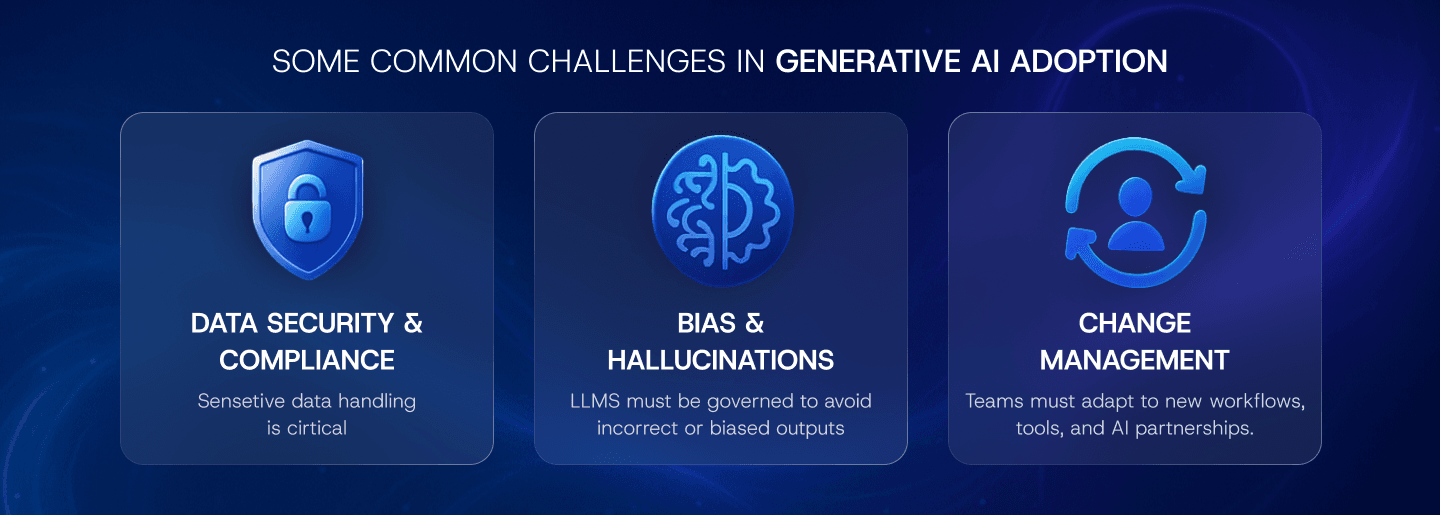
While the potential of Generative AI is transformative, organizations must navigate a few critical challenges before realizing its full value.
- Data Security & Compliance: Sensitive data handling is critical.
- Bias & Hallucinations: LLMs must be governed to avoid incorrect or biased outputs.
- Change Management: Teams must adapt to new workflows, tools, and AI partnerships.
TechChefz POV: Why Most Enterprises Fail to Scale GenAI
Most large organizations hit a wall with GenAI due to:
- Lack of integration with enterprise tech stack
- Fragmented data and weak governance
- Organizational resistance to change
- Absence of a cross-functional AI strategy
At TechChefz, we help you overcome these barriers by:
- Deploying AI accelerators tailored to your CMS, martech, or data stack
- Building intelligent knowledge retrieval systems (RAG + vector DB)
- Training teams to adopt and scale AI safely and strategically
🔍 Explore how leading organizations are turning AI ambition into business outcomes. 👉 Beyond the Hype: What GenAI Means for Real Business Outcomes in 2025
Ready to lead the way in AI-powered transformation?
At TechChefz Digital, we are at the forefront of developing LLM-driven solutions that empower businesses to innovate and stay ahead of the curve. If you're ready to integrate AI-powered agents into your operations, we’d love to connect and explore how we can support your journey.
To accelerate adoption, we offer our own LLM Accelerator, a streamlined framework that helps enterprises rapidly build, test, and scale intelligent agents tailored to their specific business needs.
Ready to lead the way in AI-powered transformation? Let’s take your business to the next level with LLM agents. Reach out to us today! 📩 Get in touch at [email protected] or 🔗 Visit us at
www.techchefz.com
Conclusion: GenAI Is a Business Strategy, Not a Tech Trend
As generative AI moves from lab to enterprise, it’s clear: this is not a passing phase. Companies that treat GenAI as a foundational capability, not a one-off tool, will lead the next wave of intelligent business. Ready to transition from experimentation to execution? Let TechChefz Digital be your GenAI transformation partner. Contact us today. 📩 [email protected] 🔗www.techchefz.digital
OTHER INSIGHTS
Explore More of Our Insights



























DISCOVER MORE